


SEO Fundamentals
2026 Beginners guide
What is SEO? Why SEO is important? Search engine optimization is the smart way.
Table of Contents
Why is SEO so important? - SEO Fundamentals
First, it is free, unlike advertising.
A lot of people search for different things every day, and free traffic like this can be very important for a business.
Secondly, once you are ranked high in search engines, over time you will get a steady flow of traffic to that online presence or website, while almost any other digital marketing strategy can result in a sudden surge in traffic, but their power is later lost, usually fading.
And finally, why miss out on the opportunity to reach billions of internet users worldwide with your business?

SEO stands for Search Engine Optimization or search engine optimization
Search engine optimization (SEO) is the basic, fundamentals of SEO, and is all about increasing the visibility, findability, and ranking of your website or online presence in the organic search engine results lists of the major search engines, as we have just described.
To achieve this visibility, you need to be aware of three basic ingredients:
What type of content do people want or need.
How search engines work.
How to properly promote and optimize your website.
Although search engines and technology are constantly evolving, there are some basic elements that have remained unchanged since the beginning of SEO.
Unfortunately, in many cases, the actual meaning is taken into account, i.e. many people have previously written material for search engines. Fortunately, this is now changing. And search engines are starting to value and rank useful content that is relevant to consumers/readers more highly. As a result, more and more valuable writing and material are being written for readers and not just for searchers.
SEO, therefore, refers to the optimization of websites and the improvement of the position of websites, blogs or other online presences on search engine results pages (SERPs).
This type of optimization is basically geared towards increasing traffic to the organic (natural) search list positions of websites, rather than towards ad search results (Search Engine Marketing - paid ads such as Google AdWords, Facebook Meta Ads).
SEO-based writings and SEO professionals, copywriters, do not basically manipulate search engines, but still take their expectations into account. We are talking about web or online, internet search engines or search engines such as Google Search, Bing, Yahoo Search or even ASK.
Copywriters or Bloggers, the SEO professionals involved in the creation of websites mentioned above, basically create websites and the content of websites, and write them in such a way that they achieve the best results for both readers and search engines.
SEO Fundamentals, experiences, and Best Practices / SEO Best Practices
SEO is a method that follows best practices. The basics of SEO help you create content that people want to find, search for, and click on, primarily in their own language and with their own search terms.
This will result in continued organic traffic to your websites.
Some of the best, commonly used SEO practices:
- Keyword research
- On-Page Optimisation
- Technical SEO
Keyword research:
Keyword research is key. 🙂
Keyword research is the foundation of SEO. Once you've identified the keywords you want to target, you can start creating content or blogging on the topic and optimizing the content for your website to increase your rankings for those keywords.
The first step in keyword research is to understand what customers are searching for online. That's not true, because it's more important to first understand your customer base, how and what they search for, and who your real target audience is. If we can see this and get it right, we can quickly achieve success. Sometimes it's easy to find the keywords that our customers are looking for when it comes to broad concepts related to your core business.
Sometimes it's harder, and you need to create content that helps someone who isn't sure if they need to visit a permanent makeup studio, for example. For your target audience who may have uneven brows or need immediate help, you can create a page on "What is the best procedure for microblading for natural-looking permanent brows?".
Specific content such as the above - although there are fewer searches for this - but can be more effective if you are, say, an expert on the topic. And of course, in addition to this, within this narrower field, you can do extremely good keyword research. As a result of which you can find content that is barely targeted by competitors, but that customers are looking for.
Any way you look at it, anyone can get started without keyword research, but if you want to be found in the search results and not have to self-market your expert writing in your own network, I don't think you can skip this step. If you are not an expert on this subject, you should consult SEO experts. They have expensive software - which they have already purchased - that can give you great direction on the right keywords for your topic.
If you want to do this yourself, there are free and paid tools and software available. And of course, there are many professional articles, articles, and videos on the internet on the subject, listing a wide range of tools. If I were to start from the simple, Google search itself provides such a very basic option. If you type google.com into the link field of your browser and then start typing words on the subject into its search box, it will give you suggestions when you type them into the search box.
Let's just say it's one of the easiest, fastest, and free ways to start a very basic, free keyword research. The main, basic keyword itself is eyebrows, the rest, as the image shows, are eyebrow tattoo or eyebrow tattoo prices for what are called longtail, more specific keywords.

To take the above eyebrow ("szemöldök" - on the image) topic as an example, I started typing the word "eyebrows" into the search engine, and the following suggestions and keywords came up on Google.
Keyword Research - basic, free solution 🙂
If you want to know more about keywords and keyword usage, check out our article "How many SEO keywords should I use in my article?".
On-Page Optimization
It is no longer enough to write content that focuses on targeted keywords. You need to optimize the key elements of your page if you want to get results in the search engines.
Headlines, headline elements:
Sometimes it is not easy to create a headline, a series of headlines, that includes the keyword phrase. It is important that the title is easy to read and grabs the reader's attention. If the keyword you are targeting is "permanent makeup", the title "tag" could be "Best practices before you decide on permanent makeup".
URL addresses:
It is much easier to choose a URL. Most URLs can match the keyword phrase. For example, if you use the example above, you might want to use: /durable-smink/ to create the URL.
Headings:
Headlines can give Google a strong signal about the content of a page. It's best if the page title is the only H1 and all titles or subtopics are H2. For longer content, you can also use H3 title bars. These headings should be keyword optimized where possible.
Avoid using the same keyword phrase as the page title. Also, don't force a keyword or keyword phrase into a headline if you feel, think, or hear it is unnatural. To improve clarity, you can add the keyword "Microbalm" to a headline instead of "Permanent Makeup".
Format the content:
Where possible, split up large chunks of text. Instead of writing a long sentence listing problems with eyebrow furrowing, make a bulleted list. This way you can present the information quickly and in an easy-to-read format. Make an H2 for the title of the list. Then make an H3 of the items.
Internal reference:
Whenever possible, link to other content on your website, and to previous articles on similar topics, to increase the frequency with which they are found (of course, be sensible, as too frequent links are penalized by search software/bots).
Meta descriptions:
Google may create different meta descriptions for different types of queries, even if the content of the page is the same. Although these are not directly related to ranking, they can affect click-through rate (CTR) - because they appear in the description below the search headings. It is therefore important to create a meta description that encourages users to click through to your page. You can achieve this by explaining the unique offer of the page and encouraging users to click. Search engines often use synonymous keywords and target keywords to help your search results stand out.
Images:
Images on the page increase the page load time. Images are the number one reason why pages load slowly. Resize images so that they are only the size you need and not one pixel larger. They should still be of good quality. Unless you need a transparent background, save your images in JPG or the now increasingly popular Web Image, WEP format.
Then compress the image, but as little as possible to preserve image quality. Once you have resized and compressed the image, you need to rename it using the keyword phrase you are targeting. Optimize the alt text as well. Search bots use both the filename and alt text to understand the image. Avoid keyword stacking, and instead optimize the image for keywords in the same way you converted the keyword phrase into a human-readable headline that highlights the topic.
Technical SEO
Even if your website is optimized for search engines, technical problems can prevent your site from performing well for search engines.
SEO:
Not indexing or disabling indexing is the biggest mistake you can make. Not indexing a website is the second most serious mistake. Of course, only after you have made your site final and error-free. Because even worse than these is having incorrect or incomplete content indexed by search engines. Your website should be easy to index. For example, in the case of WordPress, this means that the WordPress admin must activate the checkbox Settings > Reading > Website indexability for search engines (see photo below).

However, for other websites, such as custom-developed sites, this may mean that the developer has to edit the code to change the status of the robots meta tag "index, follow" to visible, crawlable.
301 redirection:
Websites can change due to redesigns, strategy changes, brand shifts, and many other factors. Although not recommended, website URLs may change, they may change when they are updated. Google may consider a website whose content moves from one URL to another as if it were a new page. This can lose all your rankings and hard work.
cIf a backlink points to a page that returns a 404 response (page does not exist error code), it may lose all value. It is important to create redirects not only to recover the full value of the links but also to improve the user experience and let Google or any search engine know that the content has changed.
For example, you may have had all your blogs include the year, month, and date in the URL, creating unnecessarily long URLs such as "/2026/12/30/permanent-make-up/", and someone decided to update these URLs to "/blog/permanent-make-up/". You can set a redirect to the old URL so you don't lose all your organic traffic.
Sitemaps:
A sitemap is a great way to give search engines a list of URLs to index. This allows Google to crawl and index your website faster. Because a sitemap is dynamic, Google will notice any changes or new content in the sitemap.
Page maps allow you to view all the pages on your website that are crawlable or indexable. Check your sitemap file to make sure that test pages, automatically generated archives, or other pages you don't want users to access are not indexed. Once you have checked your sitemap file, send it to Google via Search Console.
Responsive, Mobile-friendly:
You've probably heard many times that the use of mobile devices to read/open web pages is growing rapidly. With the proliferation of smartphones, it has quickly become more popular than viewing/reading content on a computer.
Here is Google's mobile-friendly test to check if Google considers your website mobile responsive: https://search.google.com/test/mobile-friendly
Pagespeed:
Page speed, and page load times, have been important ranking factors for some time, but now that Google is also pushing a mobile-first mindset, they are especially important.
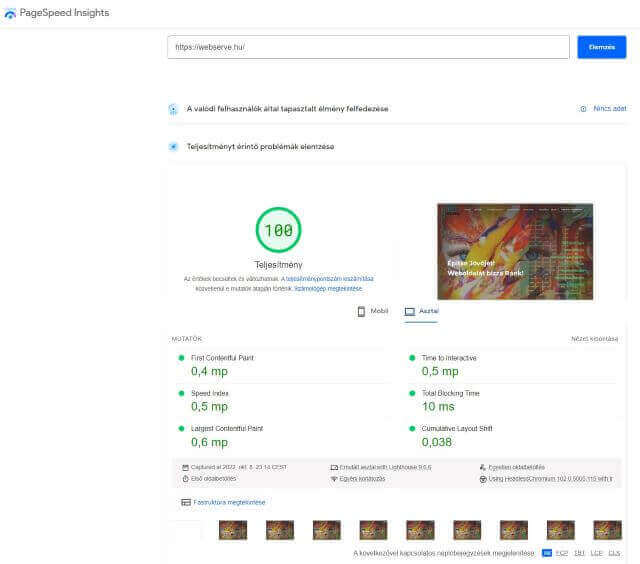


We are proud of it, but we have a lot of work to do to achieve the result shown in the pictures above. Especially the Mobile result of 97% is outstanding, but the desktop 100% is not a bad result either :)). These great results also help to rank our webserve.hu pages well.
Of course, it's not just about search engines, mobile-first, and great loading speeds, but also about improving the customer experience. Last but not least, customers don't abandon our sites because they load extremely fast on desktops, desktop computers, and mobile devices such as smartphones, tablets…
And as you have read above, there has been a huge increase in internet usage from mobile devices, smartphones, and tablets, consumption of online resources, and reading and checking social networking sites. These are also reasons why great optimization is crucial.
Think about it, how much do you use your mobile device to do this? I think maybe too much. 🙂 Many are/are like that. The search console mentioned above, for sites, also measures and monitors what devices visitors are arriving on. The link to the Google page speed tester is available here.
Google has announced Core Web Vitals, a new ranking signal that uses real data to evaluate the performance of pages. It gives a score between Good, Needs Improvement, and Poor. It can help developers improve the score and ensure that all URLs achieve a "Good" score.

To sum up:
If you do not want to achieve stable and stable results in search engines and websites' results listings, or not only with regularly paid advertisements, whether you are thinking about a custom-built website or a WordPress Website, you cannot neglect SEO and optimization of your pages for search engines.
For more on this, see our SEO courses, or check out our Web-Blog, or even our free online courses, which are constantly being developed and expanded. Or sign up for our newsletter, where you will either be notified of these or, if you prefer, you can also be sent these.
We wish you every success in the world of Websites and SEO.
If you need help, feel free to contact other professionals or contact us at WebServe.hu/en or WeBizPro.com




0 Comments